There is a price-history chart for almost everything you buy. CamelCamelCamel will show you three years of an air fryer's price. Flight tools chart fares by the day. Your brokerage charts everything down to the minute. And then you go to book a $700 hotel room, one of the larger discretionary purchases most households make, and you get a single number floating in space: tonight's quote, take it or leave it.
A quoted rate with no history is not information, it is a mood. $650 for the base room at a resort you love: is that the deal of the season or a conference-week gouge? Without the record there is no way to know, and every party in the transaction except you prefers it that way.
What a room's record actually looks like
Here is a real one: the entry room at the Park Hyatt Bangkok, as our tracker sees it, with a nightly rate observed for every stay date across the next twelve months.
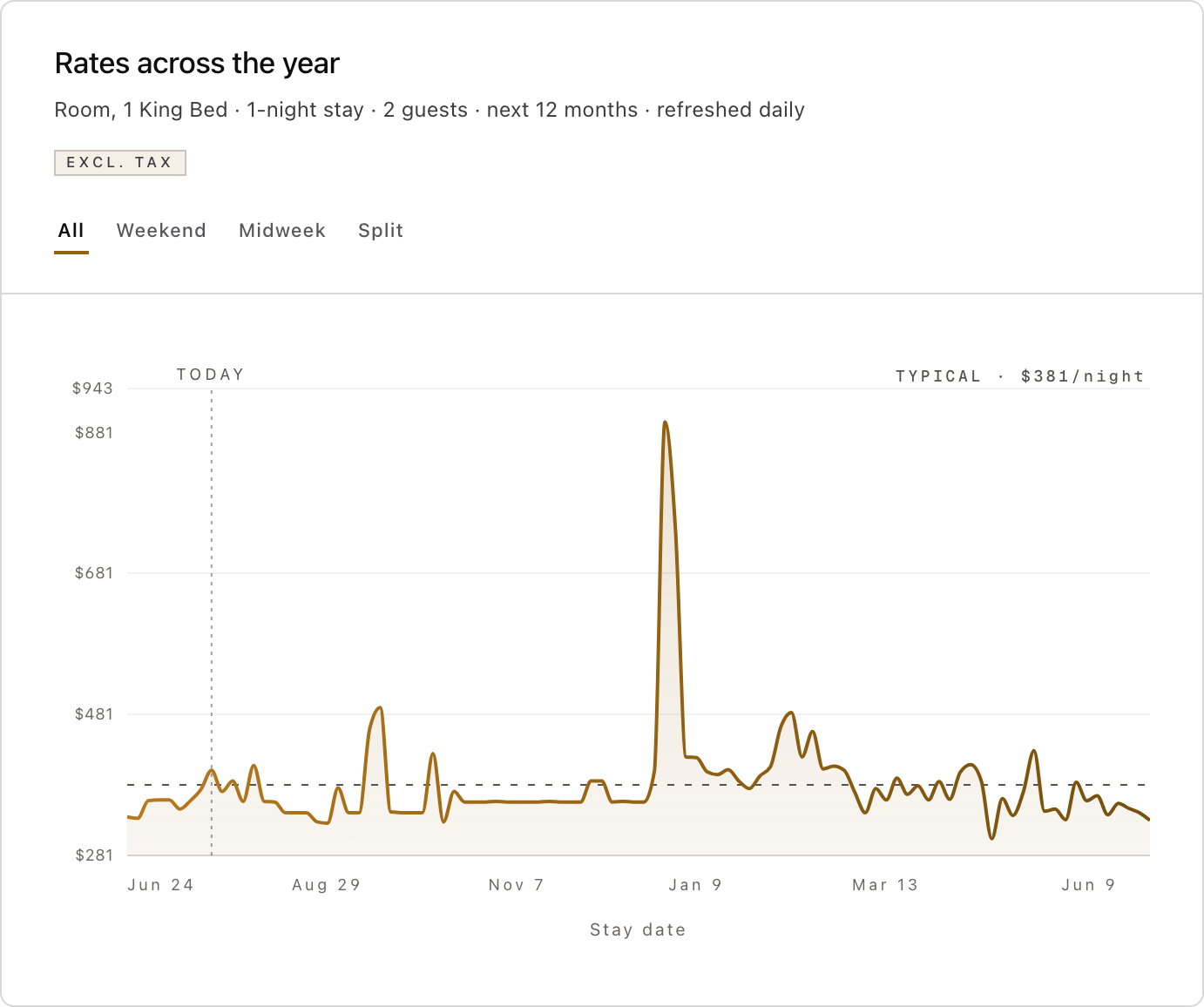
One glance tells you what no single quote can. The room's typical level is $381 a night. The floor is real but shallow: monsoon-season dates dip under $300, about 20 percent below typical. The ceiling is dramatic: the nights around New Year spike toward $900, well over double the typical level. And today's marker shows you exactly which of those regimes your dates fall into.
With that picture, a quote stops being a mood and becomes a position. $340 in September is simply the seasonal low doing its job. $340 for a December week would be an anomaly worth acting on within hours.
Why the history has to be per room
The subtle mistake in most price-history tools for hotels is that they chart the property, meaning the cheapest available room on each day. That series is a Frankenstein: a garden-view double on Monday, a promo rate on an odd room on Tuesday, the entry king on Wednesday. It moves when the composition moves, not when your room moves.
The record only supports decisions when it is the same room, apples to apples, every single night. This summer we measured how much the difference matters: on nearly one in five room-stays, a room's price behaviour diverged from its hotel's entry room at the 5 percent level. When the cheapest room dropped, the watched room failed to follow 28 percent of the time. A property-level chart would have told those travellers a story about someone else's booking.
So Fermata keeps a separate series for every category: the entry king has a record, the club room has a record, the villa has a record. More than 35,000 of them, checked nightly, over 17 million observations deep.
How to read one in thirty seconds
You do not need a finance background to use a room's history. Four questions cover it.
What is the typical level? That dashed line is your anchor. Every judgement about a quote starts from it.
Where are the lows? The seasonal troughs tell you what the room costs when nobody is competing for it, which is the realistic best case for your target price.
How spiky is it? A room that swings from $281 to $943 rewards timing and punishes complacency. A flat curve means your dates barely matter and you can book whenever suits you.
Where does today sit? Below typical and near the lows: book with confidence. Above typical: name the number you would pay and set an alert on the room, because you now know exactly what a good price for it looks like.
Where to find it
Every hotel page on Fermata shows this curve for the property's default room, publicly, no account needed; browse a destination and click through to any hotel. A free account lets you follow a hotel or track one specific room with a target-price alert, and paid tiers open the curve for every category in the building, the suites included. If you have ever wanted the CamelCamelCamel chart for a hotel room, that is precisely what we built.
The rate you are quoted tonight is one point on a curve. Book from the curve, not the point.