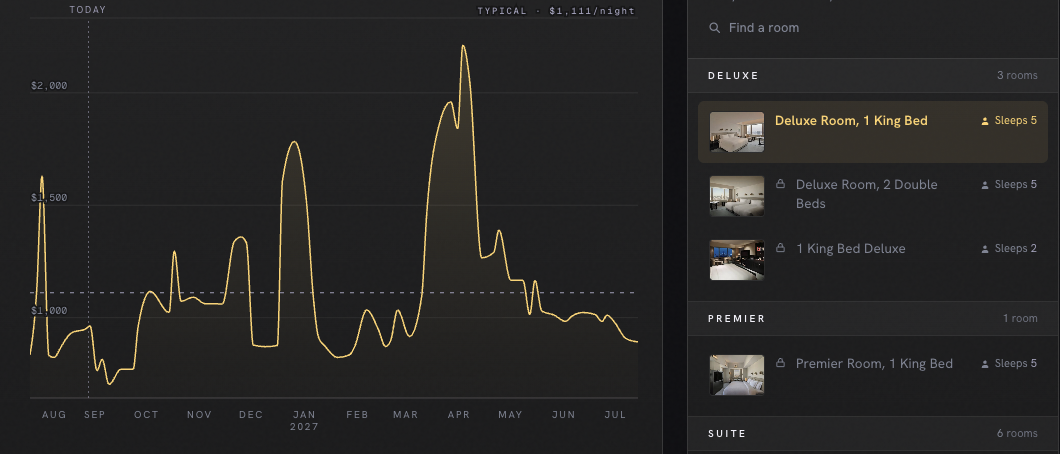
Luxury hotel rates rarely move in a straight line. A suite that looks overpriced today can be reasonable in six weeks. A resort room can jump by a third overnight when a wedding party takes the villas.
Most rate tracking fails before it starts, because it tracks the wrong number. "The Park Hyatt is cheaper this week" is not useful if the cheaper price belongs to a Twin City View room on a nonrefundable rate, and what you want is the Deluxe King, refundable, with breakfast, on August 15.
Precision is the whole discipline: the exact room, the exact dates, under comparable booking terms. Here is how to build that, and how to read what it tells you.
Track the room, not the hotel
Every booking site quotes a hotel's cheapest available room. That number is a floor across the whole property, and it moves for reasons that have nothing to do with the stay you want. It falls when the hotel releases a block of entry-level rooms. It rises when those sell out, even if the suite you want never moved at all.
Room categories at a luxury property are separate products on separate demand curves. "Deluxe King", "Deluxe Ocean View King", and "Premier Oceanfront King" can differ by several hundred dollars a night and behave nothing alike across the year. The garden-view rooms discount. The four oceanfront suites almost never do.
So the first decision is not which tool to use. It is what you are watching. If you want the plunge pool villa, the property's lowest rate tells you nothing about whether your stay is getting cheaper. It tells you about somebody else's stay.
This is the distinction Fermata is built on: it tracks the exact room category you named, not whatever is cheapest in the building.
Define the stay before you track anything
Before you watch a single price, pin the stay down in enough detail that every observation means something. Write down what has to match:
- Hotel name and location
- Check-in and check-out dates
- Number of guests
- Room category and bedding type
- View, club access, suite type, or other room attributes
- Refundable or prepaid terms
- Currency, taxes, service charges, and resort fees
- Inclusions such as breakfast, parking, spa credit, or airport transfer
This is where the first expensive mistake happens. Travelers compare the lowest public rate at a hotel against the room they actually want, and read the gap as a price drop when nothing useful has changed.
For luxury travel, the room category is part of the product. Tracking entry-level rooms will not tell you whether your stay is getting better or worse.
Understand why luxury rates move
Hotel pricing is dynamic. Properties adjust rates on demand, inventory, booking pace, local events, seasonality, competitor pricing, cancellation behavior, and revenue targets. In the luxury segment those swings are sharper, because inventory is small and room categories are highly differentiated.
A 40-room island resort has far less room for pricing error than a 500-room city hotel. If several suites sell early, what remains can reprice quickly. If demand softens or cancellations return inventory, rates can fall for a short window and then recover.
The same room also carries several public prices at once. A prepaid rate undercuts a flexible one. A package looks expensive until you account for the breakfast and the property credit. A third-party site shows a different total because it displays taxes differently.
One more thing worth saying plainly, because most trackers do not say it. Public rate tracking, Fermata's included, observes the anonymous rate: what an unauthenticated visitor sees. If you hold status with a chain, the rate you see signed in may run a couple of percent below anything a tracker records. Track the public rate for the shape of the movement. Check your member rate before you book.
| Tracking element | Why it matters | The habit |
|---|---|---|
| Exact room category | Similar names hide very different products | Save the full room name, not just the hotel |
| Stay dates | A one-night shift can change the whole rate pattern | Track only the dates you can actually travel |
| Rate type | Prepaid and refundable prices are not equivalent | Compare flexible to flexible, prepaid to prepaid |
| Total cost | Taxes, fees, and service charges change the real number | Record the all-in price when you can |
| Cancellation deadline | A lower rate is worth less if it removes flexibility | Note the last free cancellation date |
| Inclusions | Breakfast or credits can offset a higher nightly rate | Compare total value, not just room rate |
Set three numbers before you watch
Tracking works only when you know what you are waiting for. Without a target, every movement feels ambiguous. A $70 drop feels like something, but it may still sit far above a rate you would call fair. A $25 rise feels alarming, and may not matter at all.
Define three numbers, in this order.
Your walk-away price. The most you will pay for this stay, taxes and mandatory fees included where you can calculate them. A luxury rate can look manageable per night and become uncomfortable at the stay total.
Your book-now price. The rate that would make you confirm immediately. It does not have to be the lowest price theoretically possible. It should be a number you would still feel good about if the rate slipped a little afterwards.
Your aspirational target. The price you would love to see. It should never stop you from booking a good rate when demand is clearly tightening.
| Price zone | What it means | Action |
|---|---|---|
| Above walk-away | Outside your budget or value threshold | Keep watching, or choose another property |
| Between walk-away and book-now | Possible, not compelling | Monitor and compare alternatives |
| At or below book-now | Strong enough to act | Book, if terms and total cost work |
| At aspirational target | Rare value | Book before conditions change |
Fermata turns the book-now number into a target on the exact room and the exact dates. When the rate reaches it, you get an email. That is the whole mechanism, and it is deliberately the only alarm in the product. No countdown, no "only 2 left at this price", no banner.
Read the year, not just the week
A current rate tells you what a room costs. It does not tell you whether that is a good number. Two different charts answer that question, and they answer different halves of it. Most travelers only ever look at one, and it is usually the wrong one for the decision in front of them.
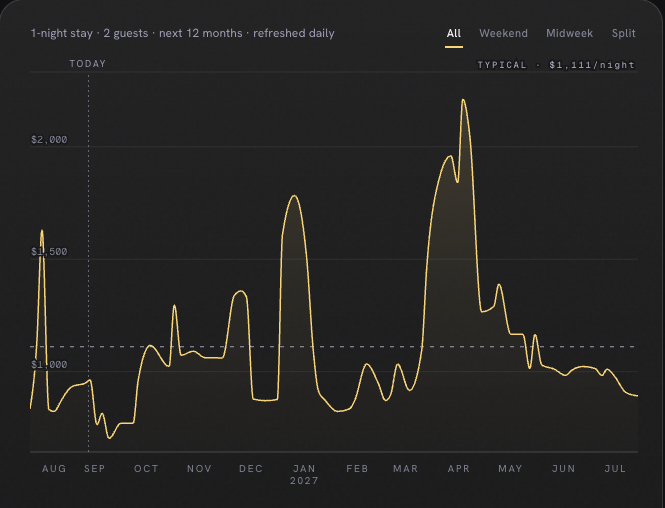
The first is the forward curve: what the same room costs across every future date, rather than what it cost in the past. Fermata builds one up to a year out for every room it tracks.
Read it for four things:
Seasonal shape. Where high, shoulder, and low season actually fall for this room, which is not always where the destination's brochure says they fall. Shoulder season is frequently the best value in the year, because the experience is close to identical and the rate is not.
The floor. Many luxury properties hold a rate they will not price below, even in a soft period. If today's number already sits near that floor, waiting for a dramatic drop is not a strategy. It is a wish.
Date-local spikes. A single Saturday priced forty percent above the Saturdays on either side is almost always an event: a conference, a festival, a race, a school holiday. Moving the stay by one week is worth more than any amount of monitoring.
Nearby dates. The cheapest way to lower a luxury hotel bill is usually to shift the stay by two days, not to wait for a discount that was never coming.
For context above the level of a single hotel, Fermata publishes rate reports built on nightly observations of public rates, and destination pages that show seasonal patterns across a country's cities.
Read the history for the stay you picked
The second chart is the price history: how the rate for your room, on your dates, has moved over time.
Once you track a room, it is re-checked every night and its history for your dates fills in.
So use the two charts for different questions. The forward curve tells you whether your dates are well chosen. The price history tells you whether today is a good moment within those dates.
What the history is good for:
- Placing today's rate. Is $1,180 high or low for this room? The number alone cannot say. The series can.
- Distinguishing flat from drifting. A rate that has not moved in three weeks behaves differently from one sliding two percent a week.
- Treating outliers with suspicion. A one-night dip may be real. It may also be a change in rate type, a dropped inclusion, or a temporary inventory adjustment. Confirm the room, the terms, and the total before you act on it.
What it cannot do is predict. Fermata does not forecast where a rate is going, and you should be wary of any tracker that claims to. It shows the record and leaves the call to you. If you want the short version of that decision, we wrote it up at should you book now or wait.
Check at a cadence you can sustain
Luxury rates move often, but not hourly. For most leisure trips nightly is the right resolution: it catches meaningful change without turning trip planning into a second job. That is exactly why it should be automated. Fermata re-checks every tracked room each night and emails you when your target is reached, which is a better use of the habit than a daily browser tab.
There is one thing a rate tracker cannot give you, and it is worth stating clearly. Price is a signal. Availability is not. No rate tracker, Fermata included, watches how many of a room category remain. If you are booking a twelve-villa resort over New Year, or a suite during a fashion week, scarcity will decide the outcome long before price does. Check availability yourself on the hotel's own site, and weight it above the rate.
If you are watching more than one trip, or more than one room type at a hotel, the number of rooms you can track at once is the thing that changes between plans. The free plan covers a single tracked room and the forward curve for one room per hotel.
Book, then keep watching
One of the better luxury hotel strategies is to separate booking from being done. A refundable rate inside your acceptable range can be booked as a hedge: it protects you from increases while you keep watching the same room for something better, right up to the cancellation deadline.
This is not always available. Some of the lowest rates are prepaid. Some resorts take deposits. Some promotional rates forbid modification. Read the terms before you assume you can cancel and rebook.
When a lower rate does appear after you have booked, compare the full terms before you touch anything:
- Same hotel, same room category, same dates?
- Refundable under similar terms?
- Same taxes and mandatory fees in the total?
- Same breakfast, credits, transfers, and other inclusions?
- Any effect on loyalty benefits or travel advisor perks?
- Enough time before the cancellation deadline to change safely?
If the new rate passes those checks, act. If it fails one or two, do the arithmetic before you decide the saving is real.
The mistakes that cost the most
| Mistake | Why it costs you | Better approach |
|---|---|---|
| Tracking the hotel's cheapest room | It is not the room you are buying | Track the exact room category |
| Ignoring taxes and fees | The final bill lands well above the nightly rate | Compare total stay cost |
| Comparing prepaid to refundable | The cheaper rate carries the greater risk | Separate rates by cancellation terms |
| Reading a trend into a thin history | A handful of pre-tracking points is not a trend | Place today's rate on the forward curve instead |
| Setting an unreachable target | You will watch a fair price go past | Set the target against the curve's observed floor |
| Forgetting inclusions | A higher rate may carry real value | Compare value, not price |
| Assuming a tracker sees availability | Scarce rooms sell while you wait for a better number | Check inventory yourself on scarce dates |
The goal is not to win every rate movement. It is to make a decision you can defend afterwards. If you booked the room you wanted, at a price you had already defined as acceptable, on terms that fit the trip, that is a good outcome even if the rate falls the following week.
A workflow you can repeat
Choose the hotel and the exact room category. Decide which dates are fixed and which are flexible. Read the forward curve to check that your dates are the right dates, and to find the room's floor. Set your walk-away, book-now, and aspirational numbers against that floor rather than against a feeling. Put an alert on the book-now number.
If a refundable rate is already acceptable, book it as a hedge and keep watching. If the rate is too high, hold, and reread the curve rather than the daily number. As the date approaches, shift your attention from price to cancellation deadlines and availability.
When the target is reached, verify the terms still match, and book.
Frequently asked questions
What is the difference between a forward curve and price history? A forward curve shows what one room costs across many future stay dates, so it tells you whether the dates you picked are expensive relative to the rest of the year. Price history shows what one specific stay has cost over time, so it tells you whether today's number is good for the dates you already chose. You want both, for different reasons.
How often should I check luxury hotel rates? Nightly is enough for leisure trips, which is why it should be automated rather than done by hand. For major events, holiday weeks, or very limited room categories, watch availability on the hotel's own site as well, because scarcity will move faster than price.
Do luxury hotel rates usually drop closer to check-in? Sometimes. Rates fall when demand runs softer than the hotel forecast, or when cancellations return inventory. They rise sharply when a property fills. A forward curve and a known rate floor are more useful than any universal rule about booking windows.
Is it better to book refundable and keep tracking? Often, if the refundable rate is already inside your acceptable range. It protects you from increases while leaving room to rebook before the cancellation deadline. Confirm the penalties and the deadline first.
What is the single most important detail to track? The exact room category, after your dates. A lower rate on a different room is not a lower rate on your stay.
Should I track the nightly rate or the total price? Watch the nightly rate, decide on the total. Taxes, resort fees, service charges, and inclusions change the value of a luxury booking materially, and they do not scale evenly with the headline number.
Track the room you actually want
Rate tracking is only powerful when it is specific. Not a "from" price, not the property's cheapest room, but the exact room, the exact nights, and the exact terms that make the stay the one you had in mind.
Fermata tracks that room. It shows the 330-day forward curve so you can tell whether your dates are well chosen, keeps the price history for your stay so you can tell whether today is a good moment, re-checks the rate every night, and emails you when it reaches the number you set.
Set the target before the market moves. Track a room at fermata.travel.