
Most advice about when to book a luxury hotel is guesswork dressed as a rule. Book 30 days out. Book 90 days out. Wait for a last-minute drop. We track Park Hyatt rates every night, so rather than repeat the folklore, we went and looked.
The short answer is uncomfortable for anyone selling a booking window: for a Park Hyatt, when you book barely matters. When you stay matters enormously.
Across 38 Park Hyatt properties, the median nightly rate for a given room on a given night was essentially unchanged whether we saw it 300 days before arrival or 3 days before. But the gap between a property's cheapest month and its priciest month was a median of 68 percent, and at some properties it was far wider than that.
You cannot time the market. You can pick a better week.
What we measured
Every figure below comes from our own observations, not from a survey or a press release.
We recorded 223,251 nightly rates across 38 Park Hyatt properties, observed between 2026-05-24 and 2026-07-04, for one-night stays for two adults.
For the booking-window analysis we isolated 30,632 room-night series: a single room category, at a single hotel, for a single stay date, observed at least four separate times. Comparing a stay date against itself over time is what lets us separate the effect of when you book from the effect of when you stay. A naive chart of price against days-to-arrival cannot do that, because the nights far in the future are also the nights in a different season.
Booking earlier does not get you a better rate
Here is what happened to those 30,632 series, grouped by how far ahead of the stay date we last saw them. "Rose" and "fell" mean the rate moved more than 2 percent in that direction over the observation window.
| Days before the stay | Room-night series | Median change | Rose | Fell |
|---|---|---|---|---|
| 0 to 30 | 3,908 | +0.0% | 43% | 41% |
| 31 to 60 | 2,963 | -0.3% | 38% | 43% |
| 61 to 90 | 2,587 | +0.0% | 39% | 41% |
| 91 to 180 | 8,233 | +0.3% | 42% | 31% |
| 181 to 330 | 12,941 | +0.1% | 39% | 29% |
Read the middle column. At every distance from arrival, the median rate change is zero to within a rounding error. The much-repeated advice to book a luxury city hotel 30 to 90 days out does not survive contact with the data: in the 31-to-60-day band, the median rate moved by minus 0.3 percent. That is noise, not a strategy.
The last-minute theory fares no better. Inside 30 days, 43 percent of room-nights got more expensive and 41 percent got cheaper. That is a coin flip with a booking fee attached.
Look at the right-hand columns, though, and something does show up. Far from arrival, rises outnumber falls by a wide margin (39 percent versus 29 percent beyond six months). Close to arrival, they even out. Rates drift upward over the long run and then churn near the end. Waiting does not earn you a discount. It just moves you from a slow climb into a coin flip.
Rates move constantly. They just do not move in a direction you can predict from the calendar
It would be wrong to conclude that Park Hyatt rates are static. They are not.
Over a six-week observation window, 47 percent of room-nights moved by more than 5 percent and 28 percent moved by more than 10 percent. The median absolute move was 4.5 percent. Prices are alive. There is real money in catching a dip.
What the data denies is that the dip is schedulable. It does not arrive at 60 days, or at 21 days, or on a Tuesday. It arrives when it arrives, on one specific room, at one specific hotel, on one specific night. Which is precisely why a target price on the exact room beats a calendar reminder.
Where the money actually is: the month you choose
Now the number that should change your plans.

At the median Park Hyatt property, the priciest month costs 68 percent more than the cheapest month. A quarter of properties swing less than 46 percent. A quarter swing more than 114 percent. (Thirty-three of the 38 properties have at least ten months of data; those are the ones counted here.)
Compare that with the zero percent you gain from booking early, and the strategy writes itself.
| Property | Cheapest month | Priciest month | Difference |
|---|---|---|---|
| Park Hyatt Kyoto | January, $1,064 | March, $3,136 | +195% |
| Park Hyatt New York | January, $1,308 | December, $3,400 | +160% |
| Park Hyatt Tokyo | August, $845 | June, $1,670 | +98% |
| Park Hyatt Zanzibar | November, $564 | June, $799 | +42% |
| Park Hyatt Paris Vendome | November, $2,904 | June, $3,986 | +37% |
Median nightly rate for that month, in US dollars, before local taxes and fees.
Every one of these has a story you could have guessed but probably could not have priced. Kyoto in March is cherry blossom season, and it costs nearly three times what Kyoto costs in January. New York peaks in December and again in September, when fashion week and the UN General Assembly land in the same few weeks. Tokyo is cheapest in the humid dead of August and September, which is exactly when the city is least pleasant and least crowded.
The most useful thing in this data: some properties barely move
Look at the bottom two rows of that table.
Park Hyatt Paris Vendome runs between $2,904 and $3,986 all year. Its cheapest and priciest months are 37 percent apart, and ten of its twelve months sit inside a $313 band. Paris is expensive in a boring, dependable way. Shifting your Paris trip by a month is close to pointless.
Park Hyatt Kyoto runs from $1,064 to $3,136. Moving a Kyoto trip from March to January saves roughly two thousand dollars a night.
This is the difference between a property whose demand is broad and year-round and one whose demand is concentrated into a few famous weeks. Before you plan around a season, find out whether your hotel even has one. You can read any tracked property's full 330-day forward curve directly, for instance Park Hyatt Tokyo, and see the shape of its year before you commit to a date.
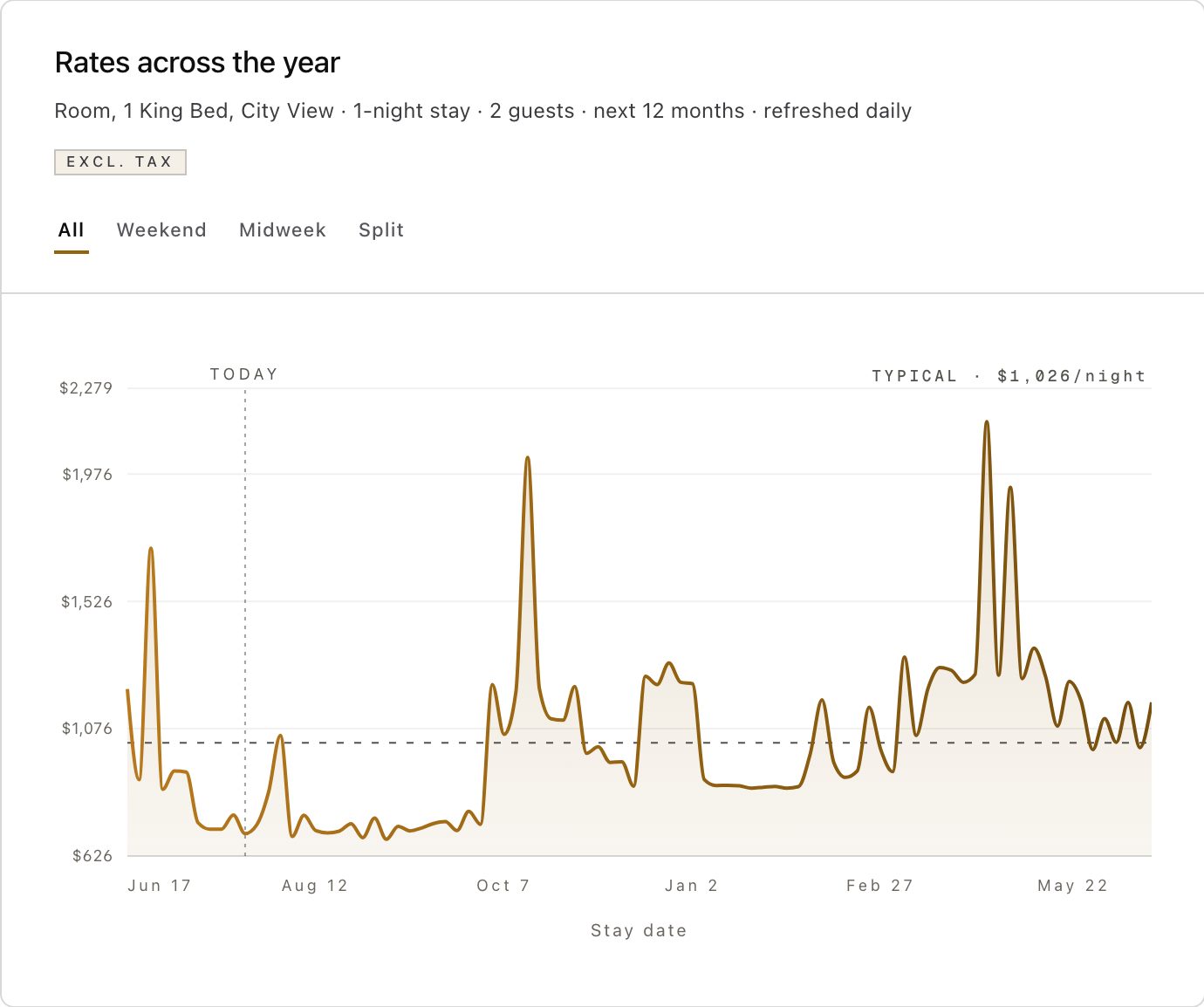
The curve above is that hotel's, for a single room category. Its flat trough from July to September, and the spikes in October, December and March, are the same seasonality the table above measures. The table averages every room category at the property, so its cheapest month is not always the cheapest month of any one room. That is the whole argument for reading the curve of the room you actually intend to book.
One smaller lever, for completeness: across the 38 properties, the median hotel charges about 2 percent more for a Saturday than a Wednesday. Real, and almost always swamped by the seasonal effect. Do not rearrange a trip for it.
So when should you book a Park Hyatt?
Given all of the above, the honest answer has three parts.
Choose the month first. This is worth a median of 68 percent, and it is the only lever in this article with a large, reliable effect. If your dates are movable at all, move them here, not by a night.
Then book a refundable rate as soon as your plans are firm. Not because early booking is cheaper, since we have just shown it is not, but because rates drift upward over long horizons and a refundable booking costs you nothing to hold. You are buying an option, not a discount.
Then track the exact room until your cancellation deadline. Nearly half of all room-nights move by more than 5 percent, and you cannot predict when. A target price on the specific room category and the specific night converts that churn into a saving. Watching a property's cheapest available rate will not do it, because the room that drops may not be the room you want.
That last point is the whole reason Fermata exists, and we have written separately about how to track the exact room rather than the hotel.
The mistakes this data actually exposes
Waiting for a booking window that does not exist. The 30-to-90-day rule showed a median change of minus 0.3 percent. You are not being clever. You are being patient about nothing.
Gambling on a last-minute drop. Inside 30 days, rates rose slightly more often than they fell. At a resort with limited rooms, you are risking the trip to win a coin flip.
Planning around the brand instead of the property. "Park Hyatt is expensive in December" is true in New York and false in Zanzibar, where December sits below the annual median and June is the peak. Chain-level seasonality is nearly meaningless: aggregate all 38 properties and the spread between the cheapest and priciest month collapses to about 15 percent, because the northern and southern hemispheres cancel each other out.
Tracking the hotel instead of the room. A rate drop on a Twin City View room does nothing for you if you are booking the Deluxe King.
Frequently asked questions
When is the cheapest time to book a Park Hyatt? There is no cheapest time to book. Across 30,632 room-night series, the median rate change was within half a percent of zero at every distance from arrival, from 330 days out to the day before. The cheapest time to stay is a different question, and for most properties the answer is worth about 68 percent.
Do Park Hyatt rates drop closer to arrival? Not reliably. Within 30 days of the stay date, 43 percent of room-nights rose and 41 percent fell. Beyond six months, rises outnumbered falls by roughly ten percentage points.
What is the cheapest month at a Park Hyatt? It depends entirely on the property, which is the point. Kyoto is cheapest in January and costs nearly three times more in March. Tokyo is cheapest in August. New York is cheapest in January. Zanzibar is cheapest in November. Read your property's own curve.
Should I book a refundable rate and keep tracking? Yes, when the refundable rate is already inside the range you would accept. Rates drift up over long horizons, so holding a cancellable booking costs nothing and protects you from that drift, while nearly half of all room-nights move more than 5 percent and give you a chance to rebook lower.
Is it worth shifting my dates by a day or two? Rarely, on this evidence. A Saturday costs about 2 percent more than a Wednesday at the median property. Shifting by a month is the move that pays.
Read your property's year before you pick your dates
Booking advice fails because it generalizes across properties that have nothing in common except a logo. Park Hyatt Paris Vendome and Park Hyatt Kyoto do not have the same year, and no rule of thumb can serve both.
Fermata shows the 330-day forward curve for the exact room you are considering, so you can see where your property's cheap weeks actually fall, set a target on the room you actually want, and get an email when the rate reaches it. Our per-market rate reports go one level up, for when the destination is still undecided.
Figures in this article are Fermata's nightly price observations as of 9 July 2026. Methodology is described at our FAQ.