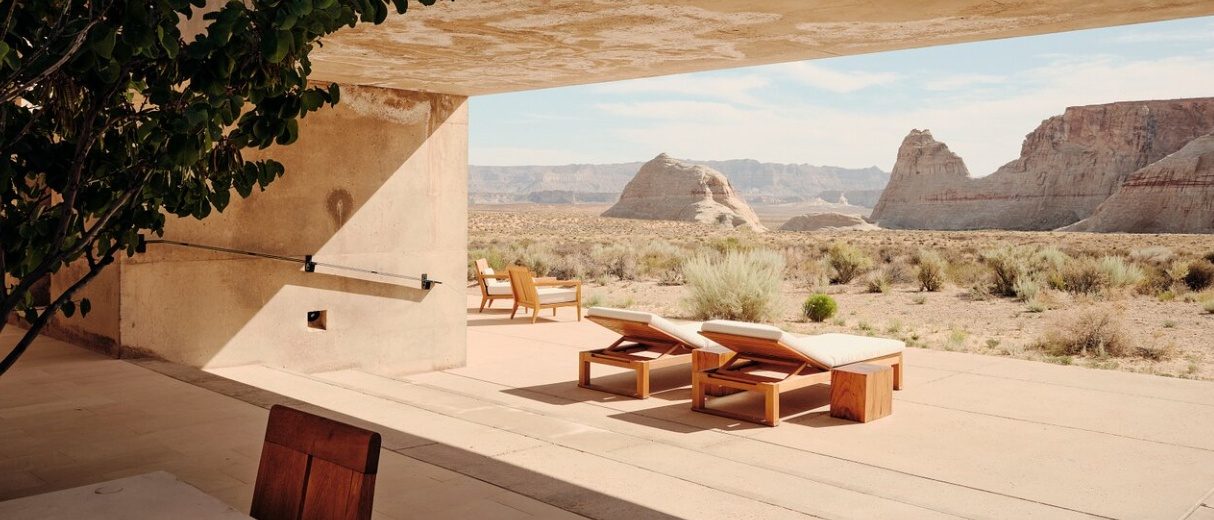
There is no coupon for an Aman. The group does not run flash sales, it does not appear on the discount sites, and the rate on aman.com is the rate. So "Aman hotel deals" is the wrong search, and people keep typing it because they can feel the price moving and cannot see how. It moves a lot. At Amangiri in Utah the same Desert Suite costs $4,223 a night on its cheapest night of the coming year and $6,914 on its dearest, taxes and fees included. That is $2,691 a night for the same bed, or more than $8,000 across a three-night stay. The saving is in knowing which of those two prices you are about to pay, and setting yourself up to pay the lower one.
Here is how to do that with Fermata, step by step, with Amangiri as the worked example. The screenshots are the live product on 25 August 2026, and every number is the one the page shows.
Step 1: Learn the range before you look for a discount
Search for the property on Fermata and open its page. Before you sign in, the page tells you where today's quote sits in the year, which is the answer most people never get.
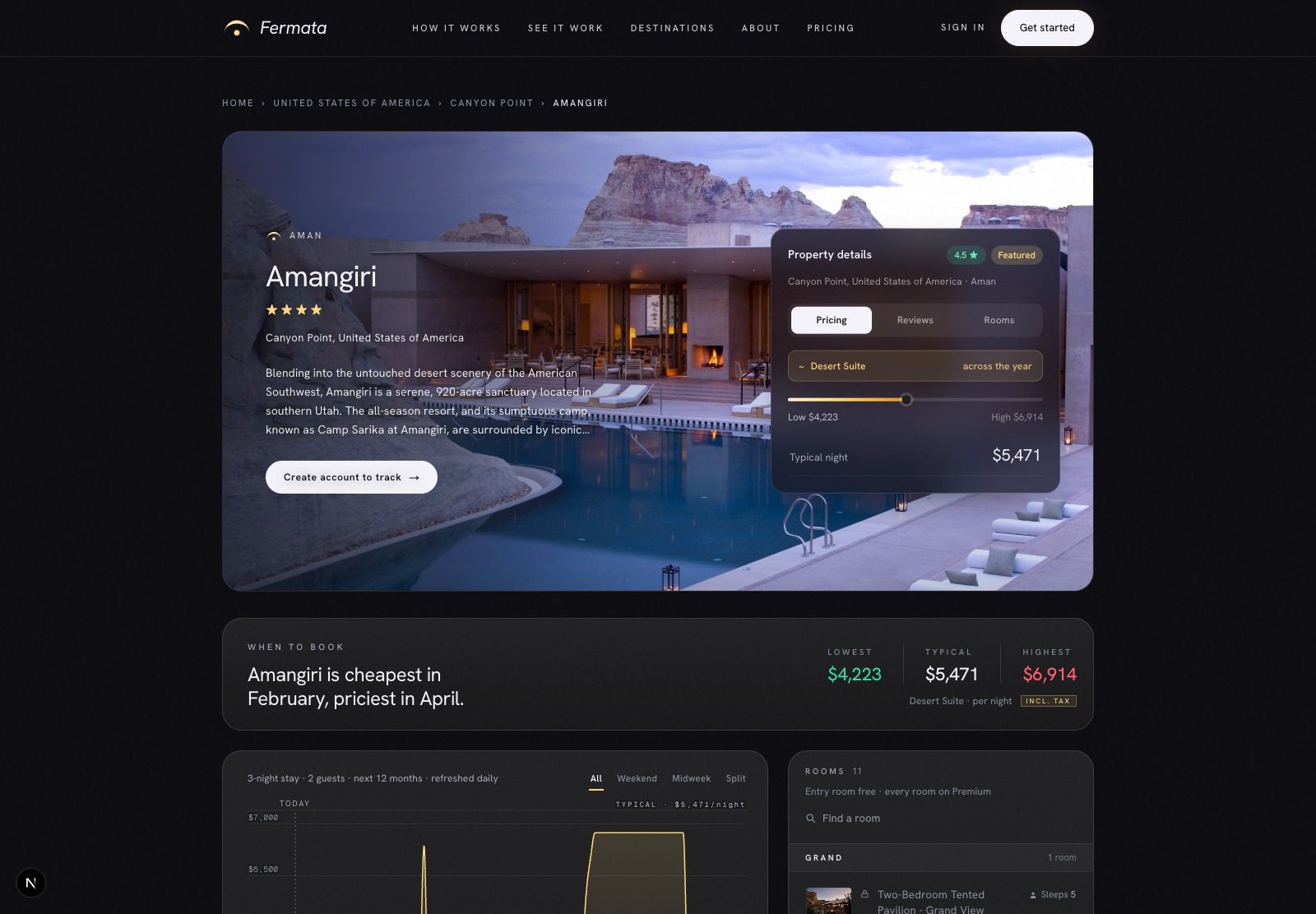
The Desert Suite, Amangiri's entry room, runs $4,223 to $6,914 across the next twelve months, with a typical night of $5,471, and the page says plainly that Amangiri is cheapest in February and priciest in April. Every Aman page carries this read, and every figure includes taxes and fees, so it is the number you would see at checkout rather than a base rate that grows by a quarter at the last step. If you have not chosen your Aman yet, the ranked list of every Aman and the Aman brand page do this for the whole group at once.
Step 2: Read the year, not the week
Scroll to the curve. This is the forward price of one room, the Desert Suite, for every stay date in the next twelve months, re-priced every night.
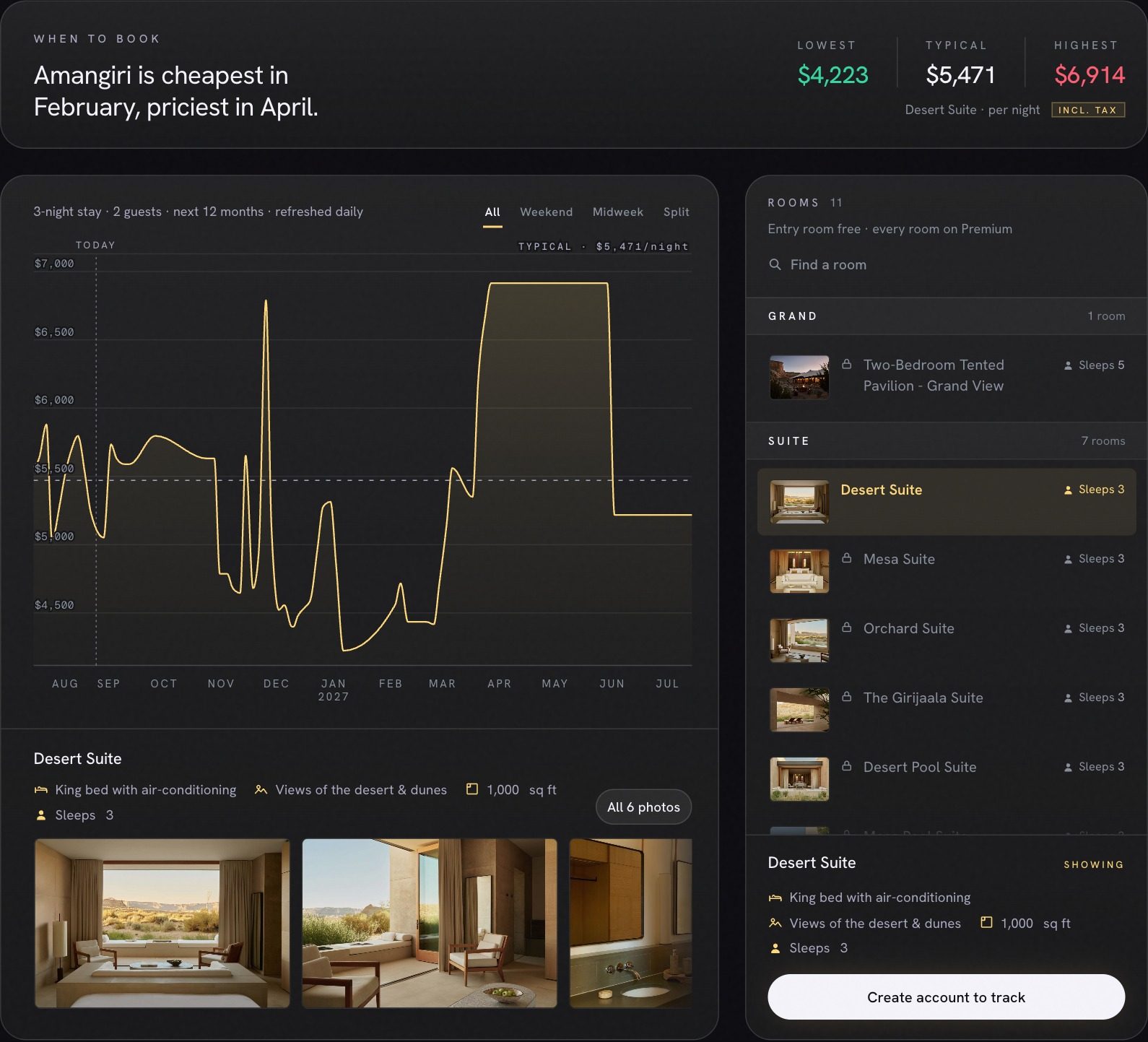
Read it the way you would read a tide table. February's typical night is $4,505 and December's $4,553, the two floors of the year. April and May are $6,914, a plateau where the resort holds its peak, and March is already on the way up at $6,104. June to October sit in the middle at $5,200 to $5,700. So the first and largest lever is the calendar. A three-night February stay in the Desert Suite costs around $13,500, and the same three nights in April around $20,700. Watching will never close a gap like that. Moving the dates closes it in one decision. Our earlier piece on how far ahead to book an Aman found the same thing across the group: the month you stay moves the price, and the lead time hardly does.
Use the Weekend and Midweek toggles too. At Amangiri weekends and midweek nights price evenly, which is unusual. At city Amans a Sunday can be a different product from a Saturday.
Step 3: Pick the exact room, not the cheapest one
The panel to the right of the chart lists every category the property sells, with the photos and facts from Aman's own catalogue and, one click away, its own curve. Amangiri has eleven: seven suites, three tented pavilions at Camp Sarika and the two-bedroom Grand View pavilion.
This is where most trackers fail before they start. A "from" price belongs to whichever room is cheapest that night, and at a property like this that is rarely the room you are buying. The Desert Suite is a 1,000 square foot king suite with a private courtyard and desert views. The Girijaala Suite is 3,742 square feet with a lap pool. They move on different curves. Pick the one you would actually book, and read its curve. The entry room's curve is free to everyone. Every other room's curve is on Premium.
Step 4: Set the stay
Press Track this room. Fermata asks for the stay, dates and party. Aman enforces a three-night minimum at most properties, Amangiri included, so we set 10 to 13 December, two adults.
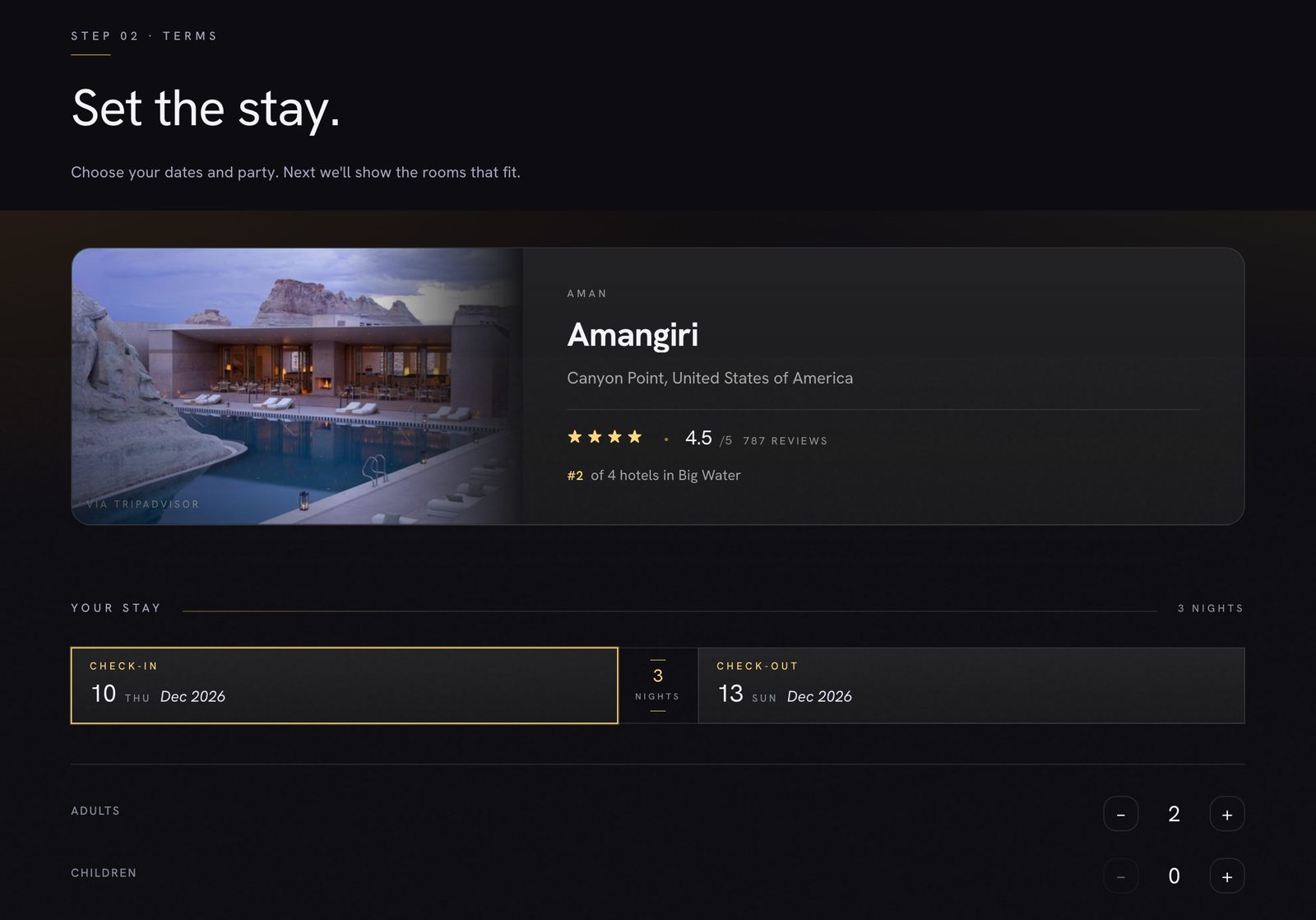
Track only dates you can actually travel. February is the cheapest month here, but a target on dates you cannot use is noise, and December's floor is within fifty dollars of it. A one-night shift can change the pattern too.
Step 5: Set a target you would book at
The last step asks for one number, the per-night rate that would make you book. Fermata puts the reference beside it, the rate the room is quoting near your dates today, and offers four ready targets: 5, 10 and 20 percent below the reference, or the lowest rate seen on the whole curve.
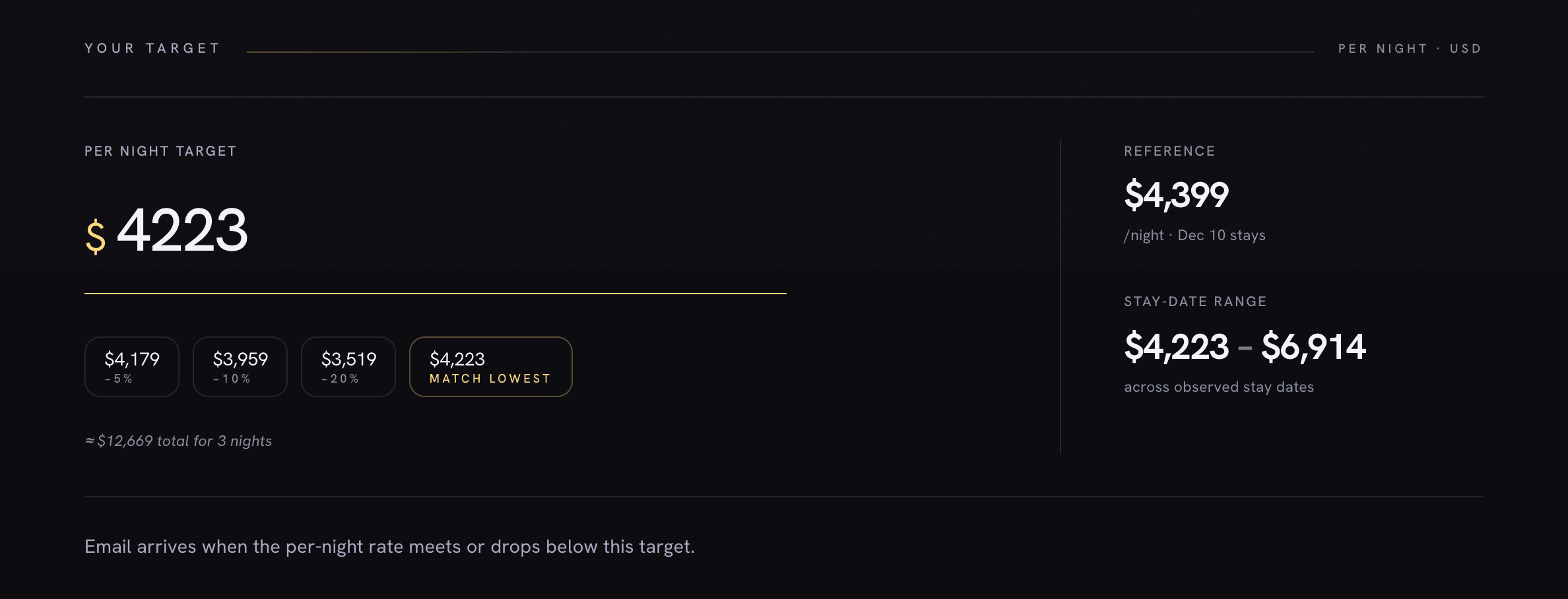
We chose Match lowest, $4,223. Here is the logic. The reference for 10 December stays is $4,399, so the room is already close to its floor for our dates. A target at the floor is a book-now number: if it lands, that is the best price this room has shown for any night in the coming year, and we should book without hesitating. A target 20 percent below the reference, $3,519, would be a wish. Amangiri has never quoted the Desert Suite there, and a tracker set below the floor will watch a fair price go past. Set the target against the curve's observed floor rather than against a feeling. Fermata shows the stay total beside it, $12,669 for three nights at $4,223, so you decide on the number you will actually pay.
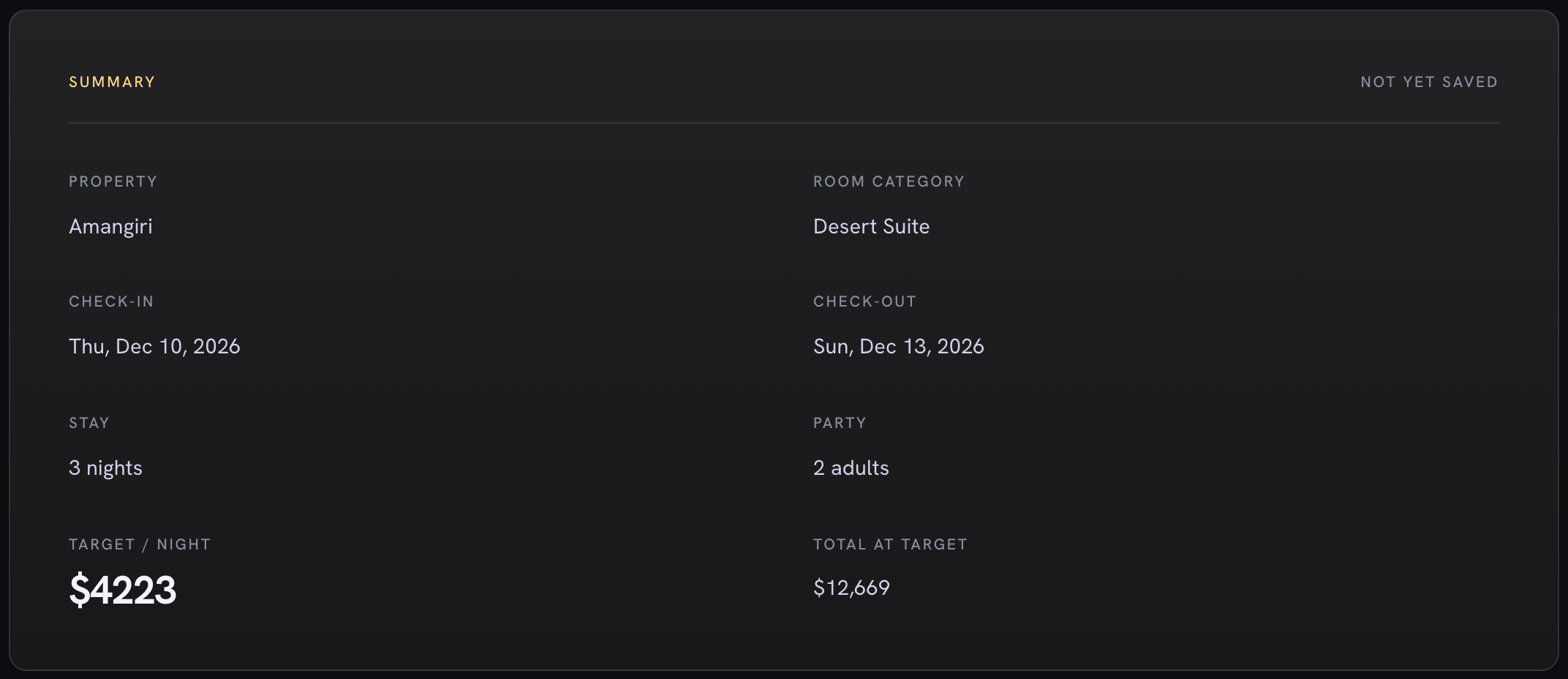
Press Start tracking. Fermata prices the room for your dates straight away, usually within a minute, then re-checks it every night and emails you the moment the rate meets or drops below your target. That email is the only alarm in the product. You will not see a countdown or a "two left at this price" banner.
Step 6: Read the tracked room, then book refundable and keep watching
The tracked room gets its own page. It shows the exact stay, the target, every nightly observation of the room for your dates, and where today's rate sits in the room's year.
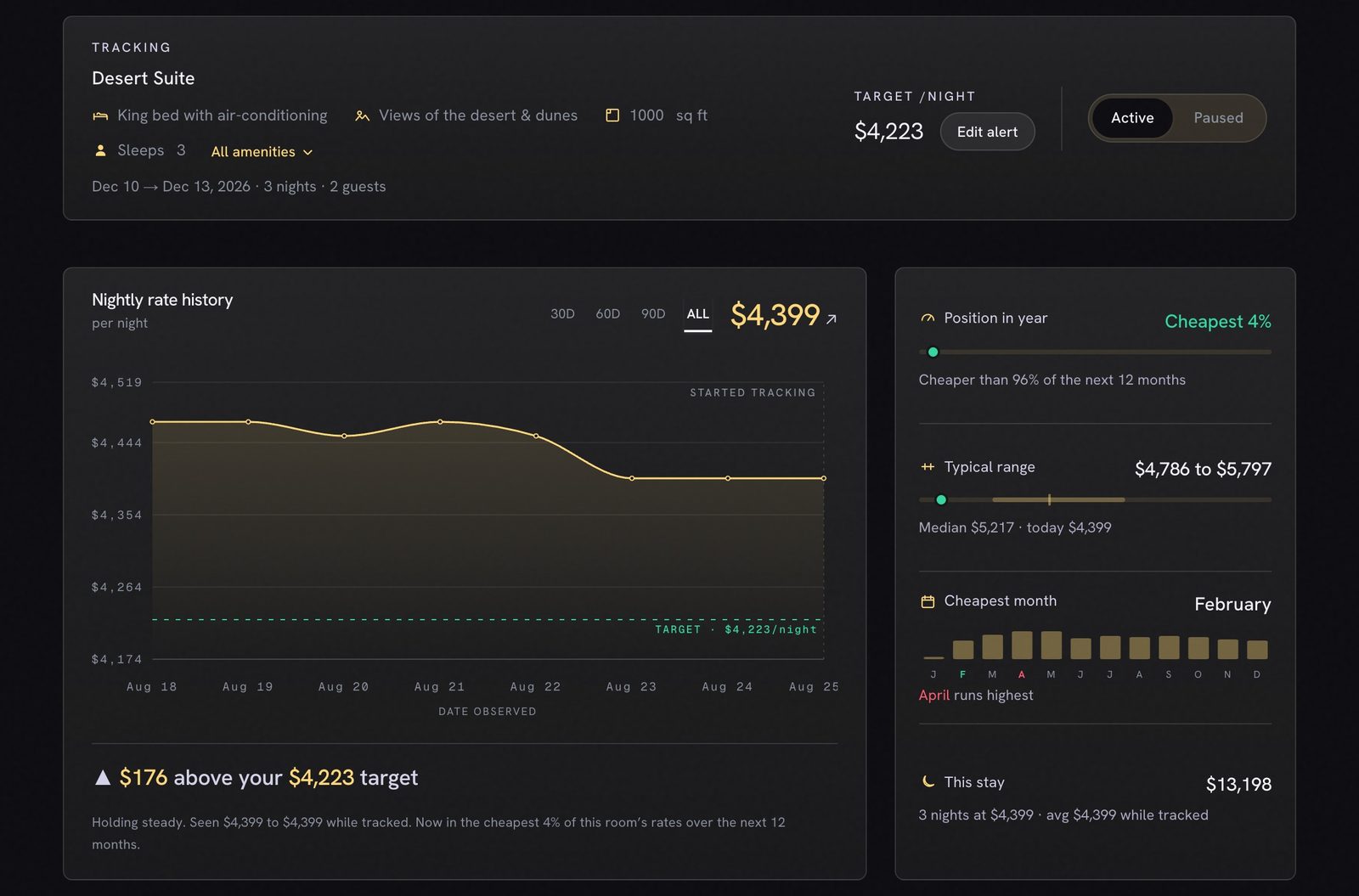
Ours came back at $4,399 a night for 10 December, $176 above the target and already in the cheapest 4 percent of everything the Desert Suite will cost in the coming year. The history shows why the number is close: the room quoted $4,470 for our dates through 22 August, stepped down to $4,399 on 23 August and has held there since. That is the read: the dates are right, the price is moving the right way, and the target has a job to do. On the Tracked page every room you watch sits in a card with its gap to target, closest first.
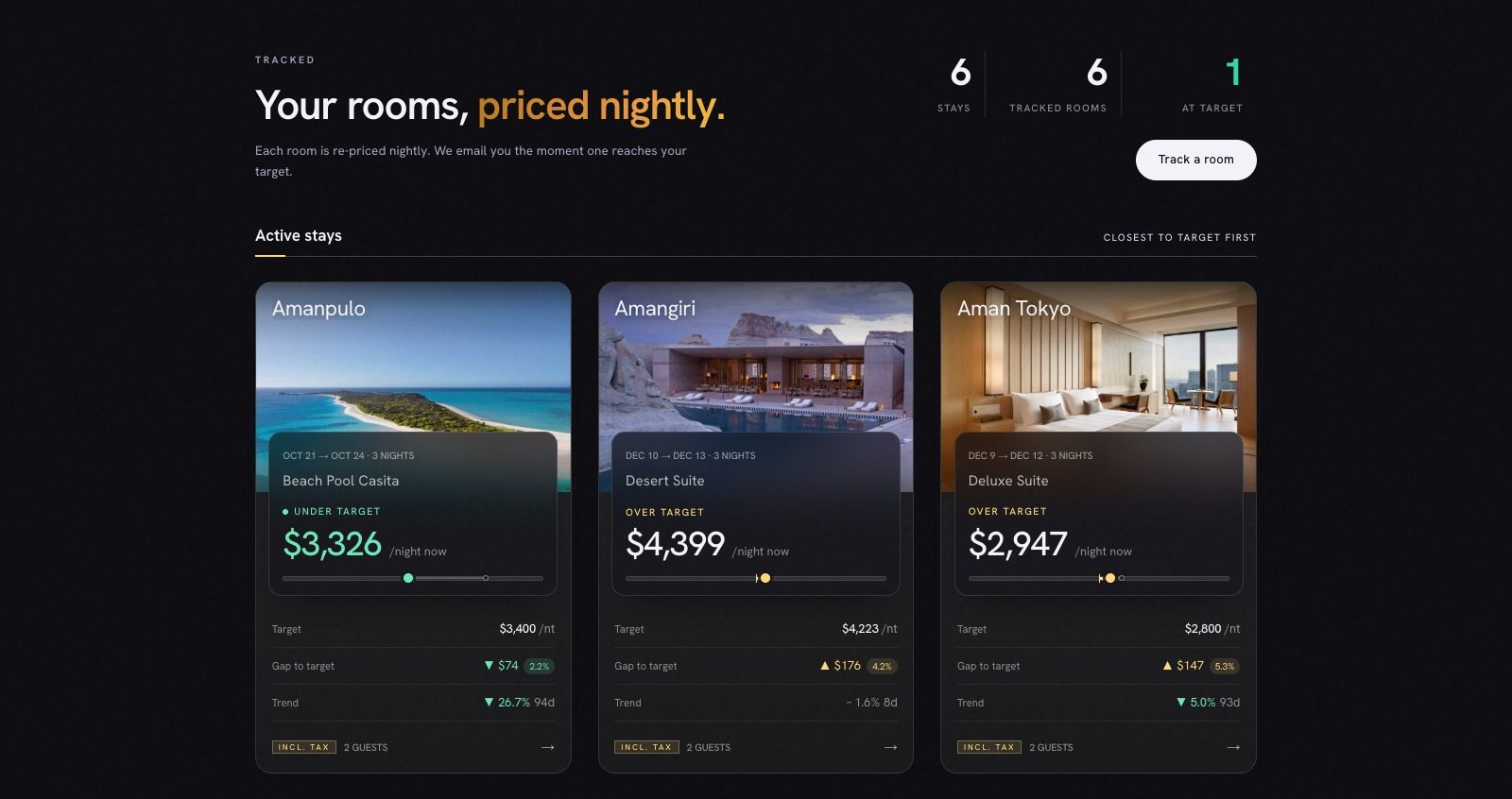
When the email arrives, or when the reference is already inside your range, book. If Aman offers a refundable rate for your dates, take it. It protects you from increases while the tracker keeps watching the same room for something better, right up to the cancellation deadline. Confirm the terms first, since some Aman rates are prepaid or deposit-based, and a lower rate is worth less if it removes flexibility.
Then keep one thing in mind that no rate tracker can see. Amangiri has 34 suites and 10 pavilions. On a holiday week the room you want sells out long before its price moves, and no curve shows you that. Book early to secure the room, ideally on a refundable rate, and track for price movement inside the season.
What Fermata does not do
We do not have codes, and nobody does. Aman publishes its own offers on aman.com from time to time, typically a longer-stay benefit or an included experience rather than a lower nightly rate. If one is running for your dates, price it against the curve, because a fourth-night benefit on a peak-season stay can still cost more than three nights in a cheap month. Aman-focused travel advisors can add breakfast, credits or an upgrade on top of the public rate. That is worth having, and it does not change which month is cheap. We watch Aman's public all-in rate every night, for the exact room. That is the part nobody else does for you.
The other kind of Aman: Amanpulo
Not every Aman rewards this much timing. Amanpulo, on its own island in the Philippines, runs its Treetop Casita from $1,579 to $2,352, with November the cheapest month at $1,663 and February the dearest at $2,184, a step of a quarter rather than a half. There the second half of the year is simply cheaper than the first, and once you have chosen the half, the tracker's job is to catch a soft week. Our own Amanpulo tracker, a Beach Pool Casita for three October nights, is already $74 under its $3,400 target in the Tracked screenshot above. On a private island reached by the resort's own plane, availability decides more than price does. Set the target, then secure the casita.
Frequently asked questions
Does Aman ever have deals or sales? Not in the sense of a discount code or a flash sale. Aman's nightly rates move with the season and with demand, by more than half at some properties between the cheapest and dearest month, and its own offers are usually stay-longer benefits or inclusions. The saving comes from the month, the room and a target on the public rate.
What is the cheapest month at Amangiri? February, at a typical $4,505 a night for the Desert Suite as of 25 August 2026, with December close behind at $4,553. April and May are the priciest at $6,914. All figures include taxes and fees.
How much does Amangiri cost per night? Around $5,471 a night for the Desert Suite across the next twelve months, ranging from $4,223 to $6,914. Larger suites and the Camp Sarika pavilions cost more, and each has its own curve on the Amangiri page.
Can I track Amangiri for free? Yes. The free plan tracks one room and shows the entry room's forward curve at every hotel. Every other room's curve, and more than one tracker, are on the paid plans.
Do Fermata's Aman prices include taxes? Yes. Every Aman figure on Fermata is the all-in nightly rate, taxes and service charge included, so the target you set is the number you would pay.
Set the target before the season moves
Choose the Aman, read the year, pick the exact room, set the stay, and put a number on it that sits near the room's floor. Then let Fermata watch. The methodology behind the figures is written up in full, and the longer guide to tracking a luxury room covers the walk-away, book-now and aspirational numbers in more depth. Amangiri is one property. The same six steps work at all thirty.